天照大神に関する覚書
A Note on Amaterasu Omikami
Bottle No.3 大伯皇女と中将姫
はじめに
中将姫(ちゅうじょうひめ)のお話をご存じでしょうか。葛城(かつらぎ)やその周辺に住んでいる人なら誰でも知っているお話なのですが、この地域を離れると意外と知っている人は少ないようです。
白雪姫のお話はご存じの方が多いと思うのですが、中将姫のお話の前半は、まるで白雪姫のお話しそのままなのです。だからといって「これって、白雪姫のパクリだ」なんて思わないでください。というのは、白雪姫のお話が登場するのは、19世紀、グリム兄弟の「グリム童話」。ところが「中将姫」はというと、8世紀の天平時代を生き、奈良の当麻寺に伝わる「当麻曼荼羅(たいままんだら)」という刺繍(ししゅう)で仏の世界を織り上げたとされる人物なのです。
しかも、このお話は「説話」として永く語り伝えられ、鎌倉時代の当麻寺の縁起「当麻寺流記」で文章化されているのです。
つまり、白雪姫よりも、ざっと300年以上も前に、すでに「読み物」になっているんですから。中将姫の物語と大伯皇女がどう関係あるのか?
きっとそう思われると思いますが、でもまずは、中将姫のお話をかいつまんで説明しておきましょう。
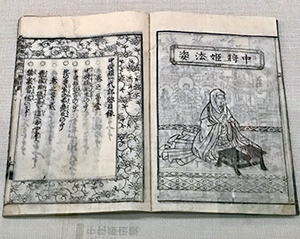
江戸時代にも人気の「中将姫物語」
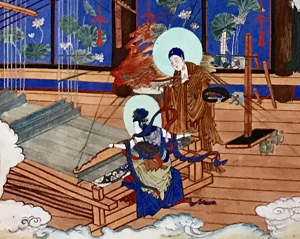
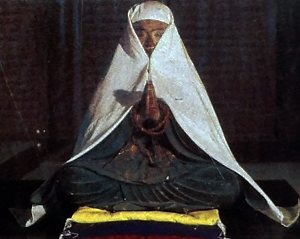
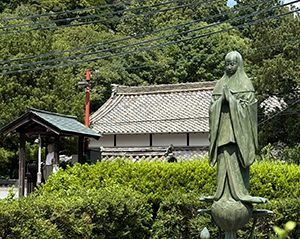
(葛城歴史博物館蔵)絵解き「中将姫物語」(当麻寺蔵) 中将姫坐像(当麻寺蔵)
1. 中将姫物語と大伯皇女
奈良に都があったころ、右大臣 藤原豊成は、「紫の前」という美しい妻をむかえ、仲むつまじく暮らしていました。二人は長谷寺の仏様に「どうか子どもが生まれますように」と願をかけ、やがてかわいい娘「中将姫」を授かり、大切に育てます。
親子は幸せに暮らしていましたが、しかし「中将姫」の母が重い病にかかり、やがて死んでしまうのです。
豊成は、二番目の妻に「照日(てるひ)の前」をむかえました。「照日の前」は美しい人でしたが、嫉妬ぶかく、自分より美しく、しかも誰からも好かれる「中将姫」が目ざわりでたまりません。大声で叱りつけたり、いじわるをしたり、あげくは「あの子さえいなければ……」と、豊成が地方赴任で留守にする時をねらい、家来に命じて、姫を殺させようとするのです。
しかし、殺害を命じられた家来は、素直で愛らしい姫をとても殺すことが出来ません。
そこで「照日の前」には、山中に連れて行き殺したと報告し、その実、姫を山奥にかくまい、妻と二人で育てることにしたのです。
地方の赴任先から帰ってきた豊成は、姫が死んだと聞かされますが、ある日、山で狩りをしていて、死んだと思っていた娘に再会することになります。家来からすべてを知った豊成は、さっそく姫を都へ連れて帰ろうとしますが、姫は、亡くなった実母との別れる苦しみや悲しさ、意地悪な継母でさえ、抑えきれない心ゆえに苦しさを抱え込んでいる、そんな人間の業(ごう)の深さ、悲しさを嘆き哀れみ、それら人々の心とともに自分自身をも供養したいと当麻寺(たいまでら)で尼となる決心をするのです。
如何にして、人はその苦しみから救われるのか、そんな寺での自問自答の日々、一つの声が姫の心に響きます。
「蓮の茎を集め、その糸を紡いで曼陀羅を作りなさい」と。
こうして苦労の末に「当麻曼荼羅(たいままんだら)」を織り終えた姫は、仏に迎えられ、母の待つ世界へと旅立っていくのです。ざっと、こんなお話なのですが、中将姫と「当麻曼荼羅」に思いを向けていると、もうひとりの女性の姿が思いの中に浮かび上がってきます。
それが、中将姫よりさらに古い時代を生きた大伯皇女(おおくのひめみこ)、「大津皇子と持統女帝」の項でも取り上げた悲運の皇族・大津皇子のお姉さんです。
大津皇子と中将姫を結びつけた作品には、折口信夫さんの「死者の書」があまりにも有名ですが、「死者の書」を読んでいると、折口さんも、中将姫と大伯皇女のイメージが深く重なっていることをどこかで感じておられたのでは……そんな風に思えてしまいます。
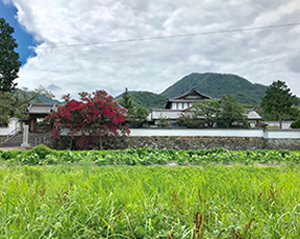
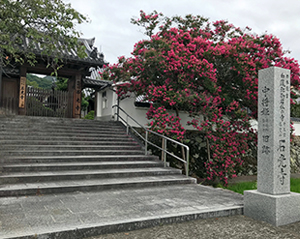
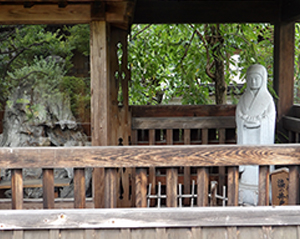
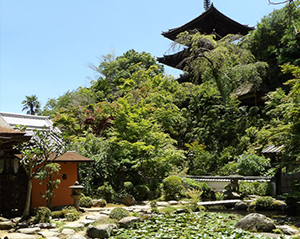
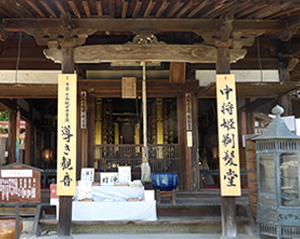
二上山の麓・石光寺(奈良県葛城市) 石光寺山門(奈良県葛城市) 中将姫が蓮糸を染めたという染井(石光寺境内) 二上山の麓・當麻寺(奈良県葛城市) 中将姫剃髪堂(當麻寺境内) 當麻寺境内の中将姫立像
2. 神さまの中央集権
少し前章の「大津皇子」のお話を思い出してください。 大伯皇女と大津皇子の兄弟は、天武天皇を父に、大田皇女を母に生まれました。大田皇女には妹の鸕野讃良皇女(うののさららのひめみこ)がいますが、二人ともに天武天皇に嫁いでおり、妹と天武の間には、大津皇子より一歳上(?)の草壁皇子が誕生しています。
本来なら大田皇女が皇后でもあり、その子、大津皇子が、天武の皇太子となるはずでした。ところが大田皇女は早くして亡くなり、大伯皇女と大津皇子の姉弟は、後ろ盾を亡くしてしまうのです。
しかも叔母である鸕野讃良皇女は、母のような美しくやさしいタイプではなく、政治力もあり、夫とともに壬申の乱を戦い抜くような権力志向タイプの女性です。夫とともに近江朝を倒し、皇后として権力の座についた時点で、彼女にとって大津皇子は邪魔な存在になってきました。というか、彼の父親譲りの英邁さが、争いの種になってきたのです。我が子草壁と姉の子大津、この二人が何をしなくとも、彼らを取り巻く勢力が、第二の壬申の乱を引き起こさないとは限りません。
こうして大津皇子の悲劇が起こるのですが、これについては、「大津皇子と持統女帝」を参照していただくとして、ここでは大伯皇女について話を進めていきます。天武天皇は、壬申(じんしん)の乱に勝利し飛鳥浄御原宮に都を営むや、戦後処理にかかります。
最重要課題が豪族らの中央集権化です。天武は、その方法として豪族らが祭る神々の中央集権化を、まず計りました。
戦勝は東海の豪族たちの力があったからこそです。そして、彼らの崇拝する太陽神、天照大神の加護があったからこそ戦いに勝てたのだと、天照大神を国家神として祀り、その下に各豪族の神々を、天孫降臨の時に付き従った神々を「天つ神」、土着の神々を「国つ神」として、神さまの中央集権化をおこなったのです。
今、韓国のテレビドラマで「高麗契丹戦争」が人気を博しています。契丹の侵攻にさらされた高麗の国。この国難を高麗8代王・顕宗が如何に乗り越えていくかを描いた歴史劇ですが、このドラマの中でも、契丹の侵攻以上に、国内の豪族の扱いが如何に困難であるかが如実に描かれています。豪族の勢力を如何に削いでいくかが、国内統一の最大の要になっているわけです。
これと同じことがわが国でも、天武の改革の中心になっています。豪族の力を借りて近江政権を打破した天武帝であり、豪族の力が如何に脅威になるかを熟知していました。
その天武が壬申の乱後、最初に手掛けたのが豪族の軍事力・経済力を天皇の絶対的な権威に組み込んでいくことです。
その際に取った政策の目玉が、先にあげた「天照大神と天孫降臨」だったのです。東海ほか海洋民が古くから崇拝してきた太陽神・天照を唯一絶対の神に祭り上げるとともに、天照から与えられた三種の神器を持つ天皇家こそが地上の絶対的支配者という位置づけをおこない、天照大神を頂点として豪族の神々を、そのヒエラルキーに組み込んでいく。
このため、伊勢神宮が創設され、国家神である天照大神のお世話をする女性が皇族の中から選ばれることになりました。
斎宮制度がスタートすることになったのです。
では斎宮とは何でしょうか、少し前、僕が斎宮制度について書いた紀行文がありますので、まず、それを紹介させてください。
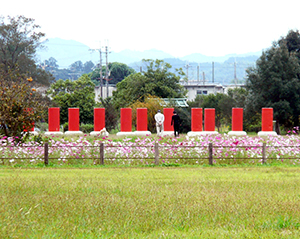
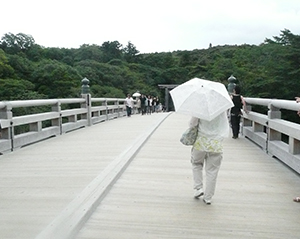
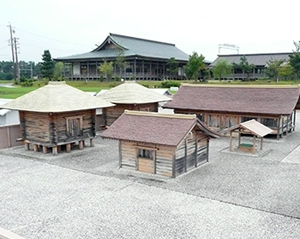
藤原宮跡(奈良県) 伊勢神宮内宮へ向かう宇治橋と大鳥居(三重県) 斎宮御所跡と「いつきの宮体験館」(三重県) 藤原京、伊勢神宮、斎宮御所、この3つはすべて、同時期に、天武・持統天皇の改革で生まれたもののようです。
3. 初めて斎宮となった大伯皇女
伊勢に仕事で出かけることがありました。
旧伊勢街道を息子の運転する車でドンドン走り、櫛田川を越えた辺りで「斎宮(さいぐう)の森」「斎宮歴史博物館」「斎宮歴史体験館」を示す表示板に出くわしました。
その表示を見るなり、それが気になって仕方がないのです。息子に「悪いけど、ここへ寄ってよ」と頼み込み、道を右折し、一路、斎宮の森を目指すこととなりました。
斎宮は、「さいぐう」とか「いつきのみや」と読みますが、では斎宮(いつきのみや)とは何でしょうか。一頃の僕は、近世の日欧交渉史に興味を抱き、キリスト教を中心とした文化摩擦のことばかりほじくり返していました。それも「孤児たちのルネサンス」を書き上げたことで、ひとまず自分の中では決着がつけられるようになったのですが、その後に登場したのが、関東から関西へ帰ってきて落ち着いた引っ越し先、「北葛城郡広陵町馬見」という場所です。
日本という国が成立した舞台、つまり欽明(きんめい)、敏達(びだつ)から推古(すいこ)を経て天武に至る古代史のまっただ中へ降り立った、そんな感じなのです。散歩コースにある牧野古墳(ばくやこふん)は敏達の息子・押坂彦人大兄皇子(おしさかひこひとおおえのみこ)の墓と言われています。同じく散歩コースの新木山古墳(にきやまこふん)、その近くには十市皇女(とおちのひめみこ)の墓があると言われる「赤部」、高市皇子(たけちのみこ)の墓と言われる見立山古墳(見立山近隣公園)。行くところ行くところが、古代史の、しかも日本という国が成立した時代の舞台となった場所。法隆寺は自転車で20分、飛鳥は自転車で1時間半、卑弥呼(ひみこ)の墓と言われる箸墓古墳(はしはかこふん)や大神神社(おおみわじんじゃ)、それに元伊勢と言われる檜原神社(ひばらじんじゃ)へは自転車で1時間。二上山登り口へは自転車で30分。そんな場所にいて古代史に心が向かないわけがありません。
特に二上山と、そこに眠る大津皇子。そうなんです、大津皇子について語ろうとすると、どうしても出てくるのが、大津皇子とは同母の姉・大伯皇女(おおくのひめみこ)。彼女も伊勢の斎宮でしたが、大津皇子が謀反の罪で刑せられたため、斎宮の任を解(と)かれました。そんな彼女が遠く伊勢の地で、刑死した弟を思って歌ったのが、「うつそみの人なる我や明日よりは二上山(ふたがみやま)を弟(いろせ)と我が見む」の歌。二上近辺には、この歌を彫った石碑がいろんな場所に置かれています。
恥ずかしながら、斎宮については、皇室の女性が任じられるんだろうぐらいの知識しかなく、場所も漠然と伊勢神宮の中にあるんだろうか? そんな按配で、本当のところは何も知らないのが実情でした。そればかりか斎宮の名前すらも、それに対する思いも、いつの間にか意識の底のほうに深く沈んでしまっている状態です。それが伊勢に来て、「斎宮の森」の標識に触れ、いきなり意識の表面に噴きあがってきたのです。
斎宮跡に文部省が立てた説明表示がありますが、これによると、「斎宮跡は、斎王の御殿とその事務を取り扱った役所の跡」だといわれ、「その創設は遠く飛鳥・奈良時代」にさかのぼるらしい。
では斎王もしくは斎宮と呼ばれるのはどんな役割で、どのようにして選ばれたのか。中野イツさん著すところの「斎宮物語」によると、「幼少の皇女から、うら若き皇女まで、60有余人の高貴な媛君が、伊勢の海辺近くの、穏やかな風光の地において、ひたすら、神に奉仕する清浄な日々を送られた」と言います。
つまり天皇に代わり、伊勢神宮に仕えるため都から派遣される未婚の皇女が、斎宮とか斎王と呼ばれる存在と言うことになります。
斎宮制度は、先に登場した大津皇子の姉・大伯皇女のときに確立し、それ以降、最後の祥子内親王(しょうしないしんのう)までおよそ660年間続いたと言われ、最年少が2歳、最年長が30歳であり、内親王から選ばれるのが普通ですが、内親王のない時には、親王の王女がなられたと言います。天皇が代わるごとに斎宮も交代しますが、その多くは未婚の内親王または王女の中から占いに当たった方が斎宮となったようです。斎宮に選ばれると、宮中の一箇所に初斎院が設けられ、ここで身を清め、斎宮にふさわしい知識を身につけることとなります。
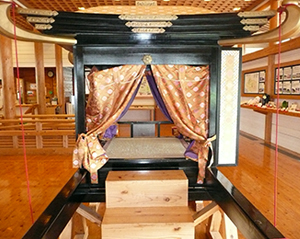
紹介する写真は葱華輦(そうかれん)という輿(こし)で、斎王はこの輿に乗って、鈴鹿峠を越え、都から伊勢の地へやってきました。
斎王は、普通は天皇の代替わりで退下(たいげ)し都に帰るか、両親のどちらかが亡くなったとき「退下」し都に帰ることになりますが、先に掲げた大伯皇女(おおくのひめみこ)は、弟・大津皇子の罪により解任されています。このような場合「事故」として都に連れ戻されるのですが、このほかにも斎王が男女関係を持ったときも、やはり「事故」として都に連れ戻されるようです。
斎王が無事任務を終え帰るときは、「退下(たいげ)」といって伊勢に群行した道を行列を整え帰るのですが、「事故」で連れ戻される場合は、別の道を密かに隠れるように帰らねばならなかったと言います。
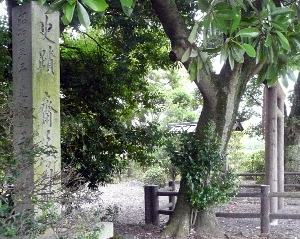
斎宮の森にある斎宮御所跡の碑(三重県明和町)
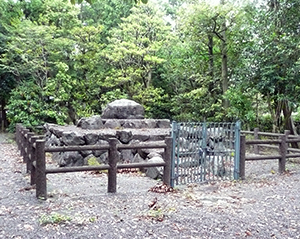
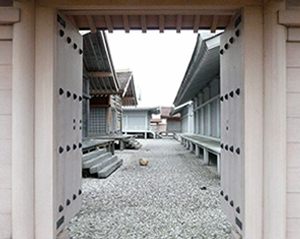
斎宮御所跡(三重県明和町) 屋外に復元された斎宮御所・内宮の模型
4. 斎宮を退下した大伯皇女
では次に、大伯皇女(おおくのひめみこ)の人生を、分かっている範囲で年表風に記してみます。
661年 天武天皇(大海人皇子)を父に、大田皇女(おおたのひめみこ)を母に生まれる。命名の由来は、百済救援のため、母大田が父に同行して筑紫に向かう途中、船が岡山県の大伯にさしかかった時に生まれたからだと言われる。
663年 弟・大津皇子が、那大津(現在の福岡県那津)に生まれる。姉同様、出陣途中の那大津で生まれたため、大津皇子と名付けられる。滋賀の大津宮からの命名ではない。
667年2月 二人の母・大田皇女が亡くなる。
672年1月 二人にとっての叔父・天智天皇が崩御する。
同年7月 壬申(じんしん)の乱が起こる。
673年 壬申の乱に勝利した天武天皇が「斎宮制度」を創始し、大伯皇女が初代斎宮に任ぜられる(12歳)。
674年 大伯皇女、伊勢に下向し斎宮に入る。
686年10月 大津皇子、飛鳥において処刑される。(この少し前に、大津皇子、男子禁制の斎宮に姉のもとを訪ねている。)
同年11月 弟の謀反の罪に連座し、大伯皇女、事故として斎宮を退下させられる(25歳)。
(16年間の空白)
694年頃 大伯皇女の発願になる昌福寺(夏見廃寺)のうち金堂が落成(博仏に刻印された年号で判明)
702年1月 大伯皇女、薨去(こうきょ)す。41歳か?
725年 大伯皇女の発願になる昌福寺が完成。この時、講堂と塔が完成している。大伯皇女が退下してからの消息が不明です。死亡年月日は分かっていますが、どこで死んだのかも分かりません。
ただ、こんなことが言われています。
平安時代の『薬師寺縁起』という文献に、大伯皇女は伊賀国名張郡に天武天皇の供養のために「昌福寺」というお寺を建立したというのです。
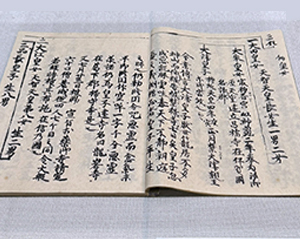
「大伯皇女は最初は斎宮なり。神亀2年(725年)をもって、浄原天皇(天武天皇)のおんために昌福寺を建立したまう。夏見と字す。もと伊賀の国名張郡にあり。」
しかも、この寺院が、天武天皇の供養のために建立されたというのは表向きで、実は大津皇子の冥福を祈るためだとする説があるというのです。
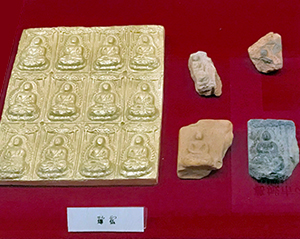
ただ、『薬師寺縁起』は、昌福寺の創建年を神亀二年(725年)としています。725年だとすると、大伯皇女が亡くなって20年以上も経っているのです。この謎ときは、意外と簡単でした。2025年9月、夏見廃寺を訪問しましたが、発掘された「金堂を飾る博仏(せんぶつ)」、これは粘土で型どりして焼かれ金色に着色されたものですが、そこに「甲午年」の刻印があったのです。つまり、この時代に「甲午」というと694年に金堂が完成していたということになります。
次いで資金面の問題ですが、大伯皇女は、大津皇子の謀反に連座して斎王を退下させられた身です。如何に皇族とは言え、国を挙げての工事とはなりません。そこで言われているのが、この地の有力豪族が、大伯皇女の発願によりスポンサーになったという考え方です。そして、今一つ、 大伯皇女の従妹であり、草壁皇子の正妃となった元明天皇が絡んでいるとも考えられます。
大化の改新で、蘇我本家を裏切り中大兄皇子に味方した蘇我倉山田石川麻呂。彼はその後、謀反の罪を着せられ、中大兄に誅せられていますが、彼の娘に遠智媛(おちのいらつめ)と、その妹姪娘(めいのいらつめ)の姉妹がおり、この姉妹が、ともに中大兄皇子に嫁いでいるのです。
元明天皇は、この姪娘(めいのいらつめ)を母としており、大伯皇女や大津皇子とは従弟同士であり、多くの従妹、従弟たちの悲劇をいやというほど見てきましたし、中でも大伯皇女とは特に親しかったように感じられるのです。あくまで個人的な思いであり、資史料等に裏付けされた考えではありません。そこで大伯皇女、阿陪皇女(元明天皇)に共通する、悲しみの原点となる事件を列挙してみます。乙巳の変(大化の改新)―祖父石川麻呂の謀反事件―遠智媛(大伯皇女には母、阿部皇女には叔母)の自殺―白村江の敗戦―近江遷都―壬申の乱―十市皇女の変死―天武天皇の死―従弟大津皇子の謀反事件― 従妹大伯皇女の斎王罷免―草壁皇子(阿部皇女の夫)の変死。すべて蘇我倉山田石川麻呂の一族がからみ、加害者となり被害者となり悲劇を紡ぎ出していきました。
しかし、元明天皇も721年12月29日に亡くなっていますが、亡くなる前に後事を実子・日高皇女(44代元正天皇)に託したたように感じられるのです。余談になりますが、元明天皇は、自身の陵墓の造営や葬送を一切禁止した唯一の天皇です。そして皇位を譲った実子・元正天皇は、生涯、夫を持たなかった女帝として知られています。
大伯皇女をはじめ、43代元明天皇、44代元正天皇と、天照大神にからむ3名の女性皇族及び天皇によって、昌福寺建立が成されたのでは?
特に大伯皇女は、斎宮に選ばれた皇族です。斎宮とは、天照大神のお世話をする、いわば神事を司る巫女のトップにあたる人間です。
大伯皇女は12歳から25歳まで、斎王として、天照大神を祀ってきました。それが天武天皇供養のため仏教寺院建立の発願をしたというのです。 たしかに神仏混淆(しんぶつこんこう)という言葉もあるように、仏教と神道、どちらが「国家護持」の効き目があるかが問題であり、特に区別をすることもなく境界線も曖昧な時代ではありました。
しかし大伯皇女は、制度として人を縛り付ける「天照大神」ではなく、その救いを「仏教」に求めたのです。といって仏教が素晴らしいと言っているのではありませんので、お間違いのないように。
では、この時代、斎宮を退下させられた大伯皇女に、仏教思想が、どんな影響を与えたのでしょうか?
少し時代を戻し、仏教が導入されるまでの「巫女の役割と文化」について考えてみることにします。
大伯皇女をはじめとする巫女たちの心を垣間見る手がかりとなるかも知れません。
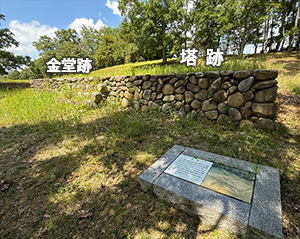
夏見廃寺(昌福寺)金堂跡/金堂は694年完成
(三重県名張市)夏見廃寺(昌福寺)壁面を飾った金堂を飾った博仏 夏見廃寺(昌福寺)塔跡/講堂と塔の完成は725年
(高さ21mの三重塔?)薬師寺縁起・複製(夏見廃寺資料館) 夏見廃寺の博仏
(「甲午の年」694年の文字が刻印されている)石光寺(奈良県葛城市)から発掘された博仏
(夏見廃寺と同じ鋳型で造られているよう)
5. 巫女の時代
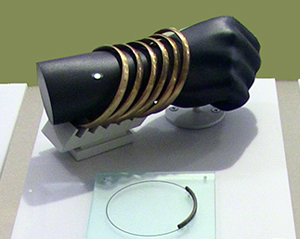
古墳時代初期には、二つの石室を持つ古墳がよく見られます。それら一方の石室には「ゴホウラ」や「イモガイ」の貝輪を右手に多数装着した人骨が発掘されるケースが多くあります。
この貝輪は女性が腕にはめる装身具なのですが、それらを子供のときから右手に多数装着した人物というのは、通常の労働をしなくても良い女性司祭者でありました。
そしてもう一方の石室に葬られているのが男王である軍事的指導者です。
つまり一つの古墳に「神事を司る女王」と「軍事を司る男王」が共に祀(まつ)られているわけです。これが後期古墳になると夫婦が一つの石室に祀られるケースが出てきますが、この頃は夫婦でなく、姉弟あるいは兄妹というペアで祀られています。
このような形態を「姫彦制(ひめひこせい)」というのですが、このような古墳に祀られるのは、いわば巫女と言っても女王と呼ばれるトップクラスの女性達です。
もちろん、その下に仕える巫女達も存在したわけで、以下は、そんな巫女達の姿を見ていくことにしましょう。巫女病(みこやみ)という病があるそうです。思春期の女性に多く現れる精神性の疾患で、沖縄に多いと聞いています。統合失調症の一種で、神の声を聞いたり、自分とは違う人格があらわれたり、俗に言う神がかり的な現象に悩ませられ、沖縄では、これを克服すると立派なノロになるのだといいます。
「精神病」と「沖縄」がなぜ……最初そう思いましたが、調べていくうち、県外に比べ沖縄に精神病患者が多いのは、「宗教」と「精神病」というものが密接な結びつきにあり、そのことと関係しているらしいということがおぼろげながら見えてきました。つまり沖縄という宗教的な土壌は、霊的に過敏な女性たち、巫女的な人たちを多く生み出してきたということです。
そんな霊的に敏感な人たちが多く存在するということと、いわゆる精神病といわれる人たちが多く存在するということが比例しているのが沖縄という精神風土のように思われます。
ただ「沖縄海洋博」が開催されるまでの沖縄では、精神的に不安定な女性たちを特別視したり、隔離したりするということがなく、集団の中でごく普通に生活し、普通に治癒していく人も多かったということのようです。
ところが沖縄海洋博が開かれるということになり、皇太子が沖縄を訪問されるということが決まったときに事情が変わってきました。今まで小集団の中で生活していた、そういう精神的に不安定な人たちが、「このままではまずい」と、精神科のある病院に収容されることになったらしいのです。今ある病院だけでは足りないので、新設の精神病院が数多く誕生したとも言われています。
なぜ、こんなことを書くかというと、古代でも同じことが起こっていたと思うからです。今以上に、古代は神とか霊とかに敏感な時代でした。女性は多かれ少なかれ、家庭とか地域という小集団の中で巫女的な役割を果たしていたようです。
そのなかでも特に霊的に敏感な人たちがいました。この人達は、思春期に「巫女病(みこやみ)」と言われる症状を発症し、これを乗り越えて巫女となり、「部族」という共同体に受け入れられ祀り上げられました。乗り越えられなかった人たちは狂人となって、それでも部族の中で共同体の一員として養われていたと思われます。では、村あるいは部族、あるいは国家という共同体の中で、巫女はどのような役割を負ってきたのでしょうか。
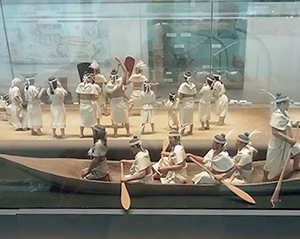
皇女や巫女(働かない女性)は右腕に貝等の腕輪
(橿原考古学研究所付属博物館)舳先に陣取り航海の安全を祈る巫女
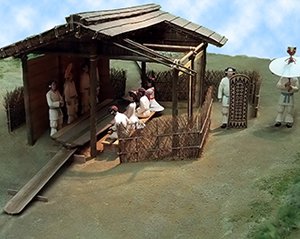
(橿原考古学研究所付属博物館)水祭りをおこなう巫女たち
(橿原考古学研究所付属博物館)① 死者を神へと導く
日本の古代で「神」といえば、古くは自然そのものを崇拝するアミニズムがんでしたが、そこへ渡来系の人たちが増えてくるにつれ、先祖を神と祀ることが多くなってきました。
渡来系の人たちが村の構成要因の主体になってくると、死者は、村はずれに葬られるようになりました。それ以前は村の中心の広場に死者を葬る場所がありました。発掘された遺跡を見る限り、縄文人は死者を中心に、それを取り囲むようにして生活していたようです。先祖に護ってもらおうという思いがあったのかも知れません。その名残りでしょうか、先祖を神と祀る信仰と一体となり、やがて氏神という共同体の神が生まれ、それが共同体を守っていくという信仰が芽生えてきます。
沖縄では、「人家相継(じんかあいけい)して七世に及べば、必ず神を生じて尊信す」と言われており、死んだ先祖の霊魂は、相当の年月と複雑な儀式を通して「神」に進化すると思われていました。
ただ放っておいて年月が経(た)てば勝手に「神」になるというものではありません。その霊魂を指導し、神へと進化させる人間が必要になってきます。その儀式を執り行うのが巫女の仕事でもあったようです。
同様に一族のものが死ぬと、先祖神の許へ送り届けるのも巫女の役割のようでした。黙っていてはどこの馬の骨か分からぬ。そこで「いついつ死んだ某(なにがし)は、あなたの何代後の子孫でありますから、迎えていただきますようお願いいたします」、恐らく、そのようなことを言上げしたうえで、目印のための家印(いえじるし)を付けて送り出したようです。この家印をつくるのも巫女の仕事でしたが、この家印が後々、家紋として発展していきます。② 神の託宣(たくせん)を聞く
高天原に在す神々を地上に降し、その神託を聞くことは神祭りを執り行う指導者として女王(巫女王)の重要な仕事でありました。そして、その神を降ろすために次の二つの方法があったといいます。
一つの方法は、蘿(かげ)(ヒゲノカズラの古名)を襷掛(たすきがけ)けにし、真拆の葛を髪に挿したうえで、笹の葉を手に持ち、空の桶を伏せて、その上に乗って踏み轟かし、跳躍して神憑りの状態に入るというものです。
また、もう一つの方法は、まず吉日を選んで斎宮に入り、琴を弾かせ、審神(さにわ=託宣を読み解く人)に問答体を以て託宣を聞かせました。その期間は七日七夜にわたり、託宣は韻文的(いんぶんてき)な律語を以てなされたといいます。
分かりにくいので少し解説を加えておきます。一つの方法は、踊り狂うことで神憑り状態になる方法です。その小道具として、ヒゲノカズラを襷(たすき)にかけ、ツルマサキという植物を髪に挿し、笹の葉を手に持って、空の桶の上に飛び乗って踊り狂いトランス状態に入っていくものだそうです。
もう一つの方法は、吉日を選んで斎宮に入ります。斎宮は後々には、伊勢神宮に奉仕した斎王の御所を言うようになるのですが、この時代にはそのようなものはなく、祈りの場所、祈るための部屋ぐらいに考えておけば良いでしょう。
その場所で琴を弾)かせます。琴と言っても今のような大きなものでなく、手で持てるような小さなもの。これは鈴の場合もあるし、梓弓(あずさゆみ)と言って、弓の弦を鳴らす場合もあります。そのうえで審神(さにわ)を同席させ、問答形式で神の託宣を聞くというものです。その場合、託宣は唄の形式で語られます。この唄の形式が後々、和歌へと発展していくことになるわけです。③ 予言者としての巫女
巫女の最も重大な役割が予言です。
天候、戦争、狩猟、疾病、航海等々、巫女が、あるいは巫女王(ふじょおう)が神聖なものとして崇拝されるのは、この予言をするためであり、これを完全に遂行するために、呪文を唱えたり、神憑りの状態に入ったりするのです。
この方法は、霊媒者としての役割と重複しますが、預言もまた唄の形式で伝えられるため、歌謡体の文辞を綴ることが、巫女の修養の一つになっていきました。④ 戦争と巫女
巫女は戦争の勝ち負けを占うだけでなく、戦争にも参加しました。
後の古代豪族に物部氏という神事を司った一族がありますが、「物部」は「もののふ」という言葉に転嫁するように、物部氏は同時に軍事氏族でもあったのです。その物部氏に「八十少女」という巫女集団がありました。「八」は日本では最高数とか満数ということですから、実際に八十人いたということでなく、たくさんいたという程度に考えておけば良いでしょう。
この巫女集団は、戦争にあっては、戦場に臨んで兵士達の背後に布陣し、戦勝を祈り、口々から「フーッ フーッ」と吐息して敵陣に吹きかけます。これによって相手を呪詛すると共に、味方の士気を鼓舞したというわけです。⑤ 農業と巫女
灌漑用水の例でも見ましたように、米の収穫高イコール国力になるのですから、国にとっても農業は最も重要な事業となります。灌漑用水のため溜池をつくるのはもちろん、「穀物神」、さらには米の収穫を左右する天候を司る神々、たとえば「水は広瀬神」、「風は龍田神」、「雨は丹生神」を祭り、これら神々の荒ぶることを恐れて、もっぱらそれを鎮めるべく呪術的祭儀が工夫されました。時には荒ぶる神を鎮めるために人身御供さえ辞さなかったようです。
この祭儀に、巫女王(ふじょおう)や巫女が関わったことはもちろんですが、巫女自体が人身御供にされることもあったと思われます。ただし、巫女が犠牲になった事実は、文献をはじめ考古学的資料、民俗学的資料をもっても証明することは出来ません……。⑥ 医者としての巫女
卑弥呼の例にも見られるように、初期道教には、懺悔によって病を癒やすという医術があり、これによって「太平道」の教祖・張角が人心を収攬し「黄巾(こうきん)の乱」を起こしました。黄巾の乱は鎮圧されたものの、これによって中国国内は乱れ三国鼎立(さんごくていりつ)の時代を迎えます。このとき発生した中国難民のうち日本に移住した者が少なからずありました……。
時を同じくして、百余国が争う倭人の国が、その一国である邪馬台国に、女王卑弥呼が忽然と登場することによって統一されたのです。
そこで卑弥呼一族は、中国からの帰化人ではないか。灌漑技術と冶金技術、さらに医療行為によって、人心を掌握していったのではないかというのが僕の考えなのですが、こういった医療行為が持ち込まれる以前にも、病を呪いで治す行為のことを「クスル」(薬の語源)というように、神憑(かみがか)りによる医療行為が存在したことが明らかになっています。
そこで巫女による医療行為を見てみると、薬などは使わず、単なる祈祷か呪術によって「病」を癒やそうとするものと、祈祷と平行して薬となるものを与えるという方法がとられていました。その薬となるモノも、神に捧げたモノ、いわゆる「お下がり」を薬代わりにするモノと、純粋に薬草などを与えるモノがあったようです。
さらに古代人の遺骨に頭頂骨を穿(うが)たれたものがありますが、これは憑依などが原因の病に対し、医療を目的とした呪術として行われたようであり、その施術は巫女によっておこなわれたのではないかと言われています。⑦ 収税者としての巫女
税という字は扁の「禾」は稲を意味し、作りの「兌」は冠を被った人の意味。
即ち神に仕えた巫女が、民衆から稲を収めさせたのが「税」の字の起りだそうです。
古代にあっては、巫女の収税は、神への「いやじり」の名で行われました。つまり神の保護を受ける為に捧げる誠意の発露として布帛(ふはく)や米などを納めたというのです。
このような経緯から、時が進み、「租(そ)・庸(よう)・調(ちょう)」の法が確立し、収税の官吏が設けられるまでは、巫女が主として徴税の職務にあたっていたと考えられます。
ここでまた沖縄の話なのですが、沖縄のオモロ(神歌)「しよりゑとのふし」の一節に、「かまへつで、みおやせ、あけしのの、おやのろ」というものがあります。
いとも頼りない訳ですが、「租税を積みましょう、あけしのの、大祝女に」という位の意味だと思うのですが……、要は、同地の巫女が租税を取立てて歩いたことを語ったものだというのです。
何かというと「沖縄」の話をいたしますが、それは沖縄には、内地の古俗が、そのまま化石化して残っていると言われているためなのです。⑧ 航海の安全を祈る
航海の安全については「持衰(じさい)」というものが「魏志倭人伝」に記されているので引用しておきます。
「倭の者が船で海を渡る時は持衰が選ばれる。持衰は人と接せず、虱は取らず、服は汚れ放題、婦人を近づけず、肉は食べず、まるで死んだ人間のようである。船が無事に航海できれば褒美が与えられるが、船に災難があれば殺される」と。
この場合、「持衰(じさい)」とは「婦人を近づけず」とあるように男の役割で、巫女とは違います。僕自身、船には女性を「けがれ」があるから乗せないのだと理解していました。ところが、このような考え方は近世のモノであって、古代の航海では、この反対に、遠路の航海には、必ず女性を同船させる慣習となっていたようです。持衰が船倉に閉じこもり、船内の悪や汚れを一身に吸着させ、船を神聖な空間に保つ役割を果たしていたのに対し、巫女は航海の安全を祈願する役割を果たしていたのでしょう。
しかし、船が海難に遭えば、持衰は「不摂生をしたためだ」と殺されますが、そのとき巫女はどうなったのでしょうか……。
ところで旅の安全を願う思いは、洋の東西を問わず、どこにでもあります。それを誰が願ってくれるかと言ったとき、世界的に、それが女性であるときが圧倒的に多いのを感じます。
昔、仕事で何度かネパールへ旅行しましたが、ネパールの友人の家では、彼の家のお婆さんが巫女の役割を果たしていました。僕たちがネパールを離れ日本へ帰るときは、その友人の家に必ず招かれ、お婆さんが巫女として道中の安全を祈願してくれるのです。その儀式の最後には、赤いティカという小麦を練ったようなものを額に付けてもらい、これで儀式は終了します。ティカはすぐ落ちるのですが、その跡が赤く残り、額に赤い印を付けたまま日本へ向かうことになります。これはこれでネパール国内や空港では便利です。何をしてくれるわけでもないのですが、この印があると、役人はじめ、みんなが親切に接してくれるというわけです。邪馬台国が大和朝廷へと律令国家への道を歩み出すに伴い、土俗の中で発生した巫女達もいつしか国家体制の中へ組み込まれていきました。
律令国家という中央集権体制の中で、地方豪族の先祖神も、ともに国家という枠組みにすくい取られていきます。
国家神・天照大神を頂点とする神々の中央集権がなされ、地方豪族のまつる先祖神も「国つ神」としてその中に位置づけられていきます。
国家神道の誕生です。そして天照大神のお世話をするため、天皇の血筋の皇女が選ばれその任に当たるという斎宮制度が設立され、その初代斎王として大伯皇女が選ばれたのです。
しかし、この時代、すでに仏教が日本にも伝えられており、国家鎮護の役割は「仏教」と「神道」の二本立てでおこなわれるようになっていったのです。
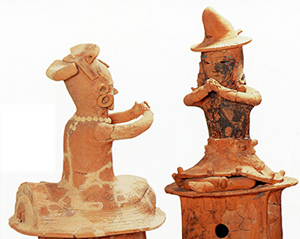
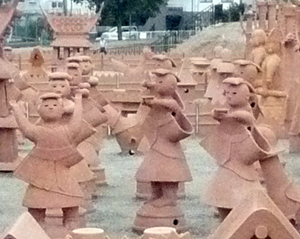
王と巫女の埴輪(群馬県立歴史博物館) 巫女集団の埴輪(大阪府茨木市・今城塚古墳) 巫女と農民(葛城考古学研究所付属博物館)
6. 仏教と巫女たち
沖縄の巫女病(みこやみ)の箇所でも触れたのですが、巫女になるためには精神的なリスクを伴います。まかり間違えば狂ってしまうことも多いわけです。
古代において巫女の役割は大きく、敵を呪う、国家の未来を占う、病人を癒やす、雨乞い等の豊年を念じ、怨霊を鎮め、国家の繁栄を祈願する……どれをとっても過度な精神的負担を伴い、失敗すれば殺される場合もある訳で、非常にリスキーな仕事だったわけです。かといって何の保証もなく、廃人になれば捨てられる。トップクラスの巫女となるか、廃棄されるか、そんな過酷な世界に生きてきたのが、古代の巫女という存在でした。
土俗信仰の時代は、村などの共同体が、神憑りになった女性の面倒を見ていたようですが、国家神道の時代になって、このような巫女たちは使い捨て状態。精神に破綻を来した巫女など、いったい、誰が面倒を見るでしょう?
このような女性たちに救いの手を差し伸べたのが仏教でした。後の世になると、女人禁制だとか言われるようになりますが、日本に仏教が伝わった頃、命がけで仏教を広めようとしたのは女性たちでした。男たちが政治の道具、あるいは国家鎮護の道具として扱っていた仏教を、精神面から受け入れたのは女性たちだったのです。善信尼(ぜんしんに)という女性をご存じでしょうか。
6世紀後半、帰化人である司馬達等を父として生まれ、11才で日本初の尼僧となった女性です。
時代は、仏教受容派の蘇我氏と、反対派の物部氏が争っており、やがて国内を二分する崇仏戦争へと発展していきます。
物部氏は、仏教受容派への見せしめとして、この11才の少女善信尼と、続いて得度した二人の少女、恵善尼(けいぜんに)と禅蔵尼(ぜんぞうに)の三人を捕らえ、海柘榴市(つばいち)の駅舎で半裸にして鞭打ちの刑に処します。
少女たちの仏教への思いは、これで萎えるどころか、ますます燃え上がり、ついには仏法を求めて百済へ渡ることになるのです。
588年、善信尼、15才。遣隋使が初めて派遣される10年も前のことなのです。
では、どうして女性なのかと言いますと、仏教受容時、日本側は「ほとけ」というものを、外来の「神」として捉(とら)えていたのです。神に仕え、神の言葉を伝えるのは、巫女という女性の役割だった――そんな風に捉えていた形跡があります。
しかし、女性たちが仏教に接してみて、そこに、精神面での「救い」という、日本の神々にはなかった思想に出会うことになります。
使い捨てのように国家に仕え、神々に仕えてきた巫女たちが、「女性でも救われる」、「極楽浄土へ生まれ変われる」という救いをそこに見いだすのです。大伯皇女(おおくのひめみこ)へ話を戻しましょう。
日本初の「斎王」として天照大神に仕えてきた大伯でしたが、弟・大津皇子が「謀反」という無実の罪で殺され、自らも「斎宮」を退下(たいげ)させられます。
世の無常をいやというほど味わった大伯の行き着いた心の拠り所が仏教でした。
無念の死を遂げた弟の苦しみ、同じように弟を死へ追いやった継母の苦しみ、そして自分自身の心の苦しみ、それらの心を癒やすために「ほとけ」という救いが、大伯には必要だったのではないでしょうか(これは中将姫が仏道に入っていった理由と全く同じです)。
これは一人、大伯ばかりではなく、たくさんの巫女たちが行き着いた答えでもありました。
心を酷使する巫女の生活の中で、彼女たちは、「心を救う」という今までなかった考え方に出会ったのです。仏師が仏像をつくるように、巫女たちが、尼となって、また織り姫となって、刺繍で仏をつくり、刺繍で極楽の世界を描いていったのではないでしょうか。
飛鳥時代、日本で最初の造像は繍仏(刺繍の仏像)だったと言います。
中将姫が蓮糸を使い、一日で織り上げたという「當麻曼荼羅」は、実は錦の綴織(つづれお)りであり、刺繍のあらゆる技術が使われていると言います。それは手慣れた織子たちが何十人も、そして何十日にもわたって紡いでいったものではないか、と推測されています。
中将姫の伝説の背景には、大伯皇女の悲劇が投影されていると思われますが、同時に、たくさんの巫女たちの悲願が込められているように思えます。仏教の到来とともに、「呪い」に、「祈り」にと精神を酷使し、豪族を支え、国家を支えてきた巫女たちも、心の救いを求めて「尼僧」へと変化していったのではないでしょうか。
斎王を運んだ葱花輦(そうかれん)
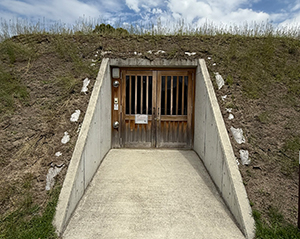
(いつきの宮体験館 三重県明和町)二上山頂の大津皇子の陵墓
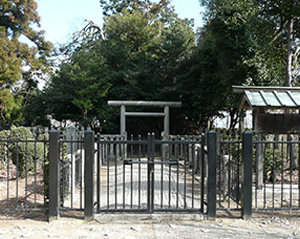
(奈良県葛城市)大伯皇女、大津皇子の母太田皇女の陵墓
(越塚御門古墳 奈良県明日香村)
おわりに/元明女帝のこと
奈良は当麻寺のすぐ近くに「石光寺」という古刹があります。この石光寺境内には、中将姫が、蓮糸を染めるために使われたという井戸が「中将姫 染の井」として残されています。
当麻寺が、中将姫の仏道修行の場であるなら、石光寺はいわば「当麻曼荼羅」製作のアトリエとでもいうのでしょうか。
そんな石光寺で、あるものが見つかったのです。
1991年(平成3年)、石光寺の弥勒堂改築に伴う発掘調査の結果、飛鳥時代後期(白鳳期)の石造弥勒仏(奈良県指定有形文化財)や、瓦、塼仏が出土したのです。
発掘にあたった橿原考古学研究所の河上邦彦さんは、
「大津皇子の供養堂として弥勒堂が建立されたと断定はできないが,この考え方を補強するのが今回出土した仏である。2種類の博仏(せんぶつ)が三重県名張市の夏見廃寺と同笵(同じ鋳型から作られたもの)である。この種の博仏は同笵のものが多くの寺で分散して発見されている。しかし、夏見廃寺は中央の官寺や大規模な寺ではない。それが大和盆地内の寺と同じ仏があることは考えがたい。しかも夏見廃寺の博仏の方が類も型取りも良好である。つまり、夏見の方が先であると思われる。そして、夏見廃寺が文献と発掘の成果から大来(大伯)皇女の建立になる昌福寺である蓋然性が高いということを考えれば、同じ仏が夏見廃寺と石光寺で発見されたことは暗示的である。つまり、大来(大伯)皇女がこれまで皇室のかかわりのあった石光寺内に大津皇子の供養堂として建立したものではないかと考えやすくなる」と、発掘の概報(橿原考古学研究所)の中で述べておられます。
(文中、三重県の夏見廃寺とあるのは、大伯皇女が大津皇子の供養のために建立したのではないかと言われている寺院跡です)。
石光寺の創建は、天武9年(680年)頃と推定され、石光寺の敷地内に弥勒堂が建立されたのは、大津が刑死してから8年後の、持統8年(694年)頃と推定されています。
中将姫ゆかりの石光寺で発掘された日本最古の石像弥勒仏の断片。そしてこれが収まっていた弥勒堂は、大伯皇女が弟・大津皇子の供養に造営したものだと言われています。また中将姫ゆかりの當麻寺、この寺院も石光寺と同時期に建立されたものと推定されており、ここに安置された弥勒仏は、石光寺で発掘された弥勒の石仏に酷似しています。
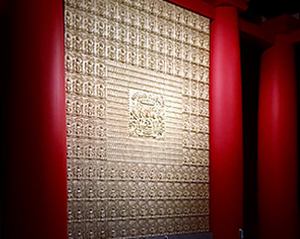
中将姫が、蓮の糸で単身織り上げたという国宝・当麻曼荼羅。これは、当時の日本にはなかったと思われる綴れ織りの技法で織られており、どうも中国・唐からの舶載物の可能性が高いようです。石光寺と大伯皇女の関わりから見て、僕などは、大伯皇女が、多くの巫女から尼僧に転じた女性たちと共に織り上げたものではないかと妄想したものですが、どうも、その可能性は薄いようです。
では、誰が、いつ當麻寺に、この当麻曼荼羅を収めたのか? この時代、唐から4メートル四方に及ぶ綴れ織りの曼荼羅を日本に運び寄贈できる力のある人物とは? そして、なぜ當麻寺なのか?
――時代は白鳳期から奈良時代前期で間違いないと思います。當麻寺や石光寺に供養目的の寄贈となると、これまでの事情を考えても、天武天皇の供養を目的として、その裏側には大津皇子の供養もあると考えられます。しかし、皇族とは言え、謀反人である大津皇子の姉・大伯皇女にそれだけの力はないと思います。そこに思いを巡らせていくと、浮かび上がってくる女性がいます。「4. 斎宮を退下した大伯皇女」のところで触れた、大伯皇女の従妹であり、第43代・元明天皇、そしてその遺志を継いだ第44代・元正天皇。大化の改新から、大伯皇女と共に、一族の権力をめぐっての争いを乗り越えてきた女性です。
今は、僕の妄想の中でしかありませんが、中将姫伝説の背景に、天照大神の呪縛から逃れようともがき続ける大伯皇女や巫女たち、そして元明女帝の姿が、どうしても重なってしまいます。
最後に繰り返しになりますが、元明天皇は、自らの死に当たって、御陵の造営をはじめ、殯(もがり)等、一切の葬送儀礼を禁じた 唯一の天皇でありました。


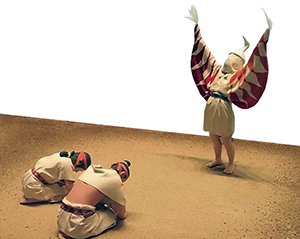
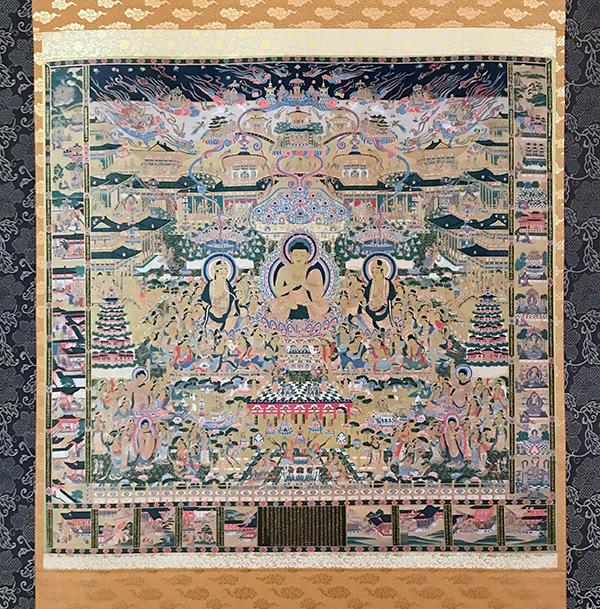 |
| 當麻曼荼羅の複製品(當麻寺蔵 4m×4m) |
Bottle No. 3 – Princess Ōku and Princess Chūjō
Introduction
Have you ever heard the story of Princess Chūjō?
If you live in Katsuragi or its surrounding region, it is a tale that everyone knows. Yet, once you step outside this area, surprisingly few people are familiar with it.
Many of you may know the story of Snow White. What is fascinating is that the first half of Princess Chūjō's story is almost identical to Snow White. But please don't dismiss it by saying, "So this is just a copy of Snow White." After all, Snow White only appeared in the 19th century in the Grimm Brothers' Fairy Tales.
By contrast, Princess Chūjō lived during the Nara period in the 8th century. She is remembered at Taimadera Temple in Nara, where she is said to have woven the Taimadera Mandala, an embroidered vision of the Buddha's world.
Her tale endured as a legend, passed down for generations. By the Kamakura period, it was written down in The Record of Taimadera, the temple's founding chronicle. In other words, long before Snow White—by more than 300 years—it had already been preserved as a piece of literature.
Now you may wonder: what connection could there be between Princess Chūjō and Princess Ōku?
Before we come to that, let me first summarize the story of Princess Chūjō.
"The Tale of Princess Chūjō," beloved even in
the Edo period (Katsuragi Historical Museum)Illustrated narrative of The Tale of
Princess Chūjō (Taimadera)Seated statue of Princess Chūjō (Taimadera)
1. The Tale of Princess Chūjō and Princess Ōku
When the capital was still in Nara, the Minister of the Right, Fujiwara no Toyonari, took as his wife a beautiful lady known as Murasaki no Mae. The two lived in harmony, and together they prayed to the Buddha at Hasedera Temple for the blessing of a child. Their prayers were answered with the birth of a lovely daughter, Princess Chūjō, whom they cherished dearly.
The family lived happily, but tragedy struck when Princess Chūjō's mother fell gravely ill and passed away. Toyonari later remarried a woman named Teruhi no Mae. Though beautiful, Teruhi was consumed by jealousy. She could not bear the sight of Chūjō, who was not only more beautiful than herself but also beloved by everyone. She scolded her harshly, tormented her with cruelty, and finally, filled with resentment, plotted her death.
When Toyonari was away on an official post in the provinces, Teruhi seized her chance. She ordered a retainer to kill the girl, declaring, "If only that child were gone…"
But the retainer, moved by the princess's gentle and innocent nature, could not bring himself to harm her. Instead, he reported back that he had done as ordered, while secretly hiding Chūjō deep in the mountains, where he and his wife raised her as their own.
On his return from the provinces, Toyonari was told his daughter had died. Yet one day, while hunting in the mountains, he stumbled upon her alive. Learning the truth from the retainer, he resolved to bring her back to the capital.
Chūjō, however, had already made up her mind. She carried within her the sorrow of being separated from her late mother, the pain of enduring her stepmother's malice, and a deep awareness of the heaviness of human karma and suffering. Out of compassion for those who shared such sorrows, she decided to renounce the world and become a nun at Taimadera Temple, dedicating herself not only to her own salvation but also to the hearts of all people.
There, in days of prayer and self-questioning, she wondered how people might be freed from suffering. One day, a voice resounded in her heart:
"Gather lotus stalks, spin their fibers into thread, and weave a mandala."
Thus, after much hardship, Chūjō completed the great Taimadera Mandala. Having fulfilled her vow, she was welcomed by the Buddha and departed for the world where her mother awaited her.
Such, in brief, is the story of Princess Chūjō. Yet as I pondered her tale and the Taimadera Mandala, another figure began to emerge in my mind: Princess Ōku, who lived in an even earlier time. She was the elder sister of Prince Ōtsu—the ill-fated royal whom I wrote about in the section "Prince Ōtsu and Empress Jitō."
The work that famously connected Prince Ōtsu with Princess Chūjō is Shinobu Orikuchi's novel The Book of the Dead. Reading it, I cannot help but feel that Orikuchi himself sensed a deep resonance between the image of Princess Chūjō and that of Princess Ōku.
Sekkō-ji at the foot of Mt. Futakami
(Katsuragi, Nara Prefecture)Main gate of Sekkō-ji (Katsuragi, Nara Prefecture) "Dyeing Well" where Princess Chūjō is said to have dyed lotus threads (within Sekkō-ji grounds) Taimadera at the foot of Mt. Futakami
(Katsuragi, Nara Prefecture)Hall of Tonsure for Princess Chūjō
(within Taimadera grounds)Standing statue of Princess Chūjō
(within Taimadera grounds)
2. The Centralization of the Gods
Let us recall for a moment the story of Prince Ōtsu from the previous section.
Princess Ōku and Prince Ōtsu were siblings, born of Emperor Tenmu and Princess Ōta. Princess Ōta had a younger sister, Princess Unonosarara (later Empress Jitō). Both sisters became consorts of Tenmu, and between Unonosarara and Tenmu a son was born—Prince Kusakabe, who was perhaps a year older than Prince Ōtsu.
Ordinarily, Princess Ōta would have been empress, and her son, Prince Ōtsu, would have naturally become crown prince. Yet Princess Ōta died young, leaving her children, Princess Ōku and Prince Ōtsu, without support.
Moreover, their aunt, Princess Unonosarara, was not a gentle and graceful figure like her elder sister. She was politically astute, ambitious, and had fought side by side with her husband in the Jinshin War. Having toppled the Ōmi court with her husband and ascended to the throne as empress, she increasingly saw Prince Ōtsu as an obstacle. Indeed, his brilliance, inherited from his father, became a source of potential conflict. Whether or not he or her own son Kusakabe took action, the factions surrounding them might easily ignite a second Jinshin War.
Thus unfolded the tragedy of Prince Ōtsu, which I have already discussed in "Prince Ōtsu and Empress Jitō." Here, however, I will turn our attention to Princess Ōku.
After emerging victorious in the Jinshin War and establishing his court at the Asuka Kiyomihara Palace, Emperor Tenmu began the work of postwar reforms.
His foremost priority was centralizing the power of the great clans. And the method he first employed was the centralization of the gods they worshiped.
The victory in the Jinshin War had been possible thanks to the support of the eastern clans, and above all because of the protection of their sun goddess, Amaterasu Ōmikami. Proclaiming that victory came through her divine aid, Tenmu elevated Amaterasu as the supreme deity of the state. Under her he organized the pantheon: the gods who had accompanied the heavenly descendants at their descent were defined as Amatsu-kami (heavenly deities), while the native deities were classed as Kunitsu-kami (earthly deities). In this way, the gods themselves were brought under a system of central authority.
A parallel comes to mind from the Korean historical drama The Goryeo–Khitan War, now popular on television. The drama depicts not only the kingdom's defense against Khitan invasions but also, with equal intensity, the internal struggles with powerful aristocratic clans. It shows vividly how curbing the power of these clans was the key to unifying the nation.
The same held true for Japan. Emperor Tenmu had risen to power by defeating the Ōmi regime with the help of the clans, and he knew well the threat their strength could pose. After the Jinshin War, his first priority was to draw the military and economic power of the clans into the absolute authority of the throne.
The centerpiece of this policy was the enthronement of Amaterasu and the myth of the Heavenly Descent. By exalting Amaterasu, long revered by maritime peoples of the eastern provinces, as the sole and absolute deity, and by declaring that the imperial family—possessors of the Three Sacred Treasures bestowed by Amaterasu—were the rightful rulers of the earth, he established a divine hierarchy into which all clan deities were subsumed beneath Amaterasu.
It was for this reason that the Ise Grand Shrine was established, and a new system was created in which a woman from the imperial family would be chosen to serve the sun goddess as her priestess.
This was the beginning of the Saiō (Imperial Priestess) system.
But what exactly was the Saiō? To explain, let me first share a short travel essay I once wrote about the institution.
Site of Fujiwara Palace (Nara Prefecture) Uji Bridge and Great Torii leading to the Inner
Shrine of Ise Grand Shrine (Mie Prefecture)Site of the Saikū Palace and the "Itsukinomiya Experience Center" (Mie Prefecture) Fujiwara Palace, Ise Grand Shrine, and the Saikū Palace—all three appear to have been established
at the same time through the reforms of Emperors Tenmu and Jitō.
3. Princess Ōku, the First to Serve as Saiō
On one of my trips for work to Ise, I was driving along the old Ise Highway with my son at the wheel. After crossing the Kushida River, a sign caught my eye: "Forest of the Saiō," "Saikū Historical Museum," and "Saikū Historical Experience Hall."
The moment I saw it, I could not shake the feeling that I must go there. I asked my son, "Sorry, but could you turn off here?" And so, we veered right, heading straight toward the Forest of the Saiō.
The word Saikū can be read as saigū or itsuki no miya. But what exactly was the Saiō? At one time, my interest lay mainly in early modern encounters between Japan and Europe, especially the cultural clashes surrounding Christianity. That study came to a kind of conclusion for me after finishing my book The Renaissance of the Orphans.
Later, I moved from the Kanto region back to Kansai and settled in Umami, Kōryō Town, Kitakatsuragi District. There, I felt as if I had stepped right into the stage where the nation of Japan was being formed—into the very heart of ancient history spanning from the reigns of Emperors Kinmei and Bidatsu, through Empress Suiko, and on to Emperor Tenmu.
The Makino Kofun along my walking path is said to be the tomb of Prince Oshisaka no Hikohito no Ōe, son of Emperor Bidatsu. Nearby, the Nikiyama Kofun stands in the district of Akabe, where Princess Tōchi is believed to be buried. The Mitaruyama Kofun, said to be the resting place of Prince Takechi, lies within Mitaruyama Park. Wherever I went, I found myself surrounded by the sites of Japan's formative age. Hōryūji Temple is a twenty-minute bike ride away, Asuka about an hour and a half, Hashihaka Kofun—the tomb attributed to Queen Himiko—and Ōmiwa Shrine, as well as Hibara Shrine (the so-called "Original Ise"), are all within reach of my bicycle. Even the trailhead to Mount Futakami is only thirty minutes away. Living in such a place, how could my heart not turn toward ancient history?
Above all, my thoughts were drawn to Mount Futakami and to Prince Ōtsu, who rests there. And whenever I thought of him, I could not help but recall his elder sister by the same mother, Princess Ōku. She too had once served as Saiō in Ise, but when her brother Prince Ōtsu was executed on charges of treason, she was released from her office. Far away in Ise, she composed a poem in mourning for her brother:
"Though I am but a mortal, from tomorrow I shall see Mount Futakami as my younger brother."
Stone monuments inscribed with this poem can still be found throughout the area around Futakami.
To my shame, my own knowledge of the Saiō was vague at best. I only knew that women of the imperial family were appointed, and I vaguely assumed the office was located somewhere within Ise Shrine itself. In truth, the name and the idea of the Saiō had long sunk to the depths of my consciousness. Yet, seeing the sign for the Forest of the Saiō in Ise, the memory suddenly surged to the surface.
At the site of the Saikū, a plaque erected by the Ministry of Education explains that the remains are those of the Saiō's palace and the offices that administered her duties, dating back as far as the Asuka and Nara periods.
But what role did the Saiō, also known as the Saigū, actually serve, and how was she chosen? According to The Tale of the Saiō by Itsu Nakano, "From their early years to the bloom of youth, more than sixty noble princesses lived in the serene coastal land of Ise, devoting themselves wholly to pure service of the gods."
In other words, the Saiō was an unmarried princess dispatched from the capital to serve Amaterasu at Ise Grand Shrine on behalf of the emperor.
The system was established during the time of Princess Ōku, elder sister of Prince Ōtsu, and it continued for about 660 years until the service of Princess Shōshi, the last Saiō. The youngest appointee was only two years old, the oldest thirty. Normally an imperial princess was chosen, but if no princess was available, the daughter of a prince might be appointed instead. Each time a new emperor ascended the throne, the Saiō also changed. Selection was made by divination, and the chosen princess would first reside in a Saikū, a preparatory palace within the capital, where she purified herself and learned the knowledge required of a Saiō.
The photograph here shows the sōkaren, a palanquin in which the Saiō traveled, crossing the Suzuka Pass to make her way from the capital to Ise.
A Saiō would normally return to the capital in a grand procession, called taige, when the emperor died or one of her parents passed away. However, Princess Ōku was dismissed when her brother Prince Ōtsu was condemned. In such cases, the return was called an "accident," and the Saiō was quietly escorted back to the capital. Similarly, if a Saiō was found to have had relations with a man, she too would be dismissed as an "accident."
When a Saiō completed her service and returned safely, her procession retraced the route by which she had traveled to Ise. But when she was dismissed as an "accident," she was compelled to return secretly, by a different road.
Monument marking the site of the Saikū Palace
in Saikū Forest (Meiwa, Mie Prefecture)Ruins of the Saikū Palace (Meiwa, Mie Prefecture) Outdoor reconstruction model of the Inner Palace
of the Saikū(Meiwa, Mie Prefecture)
4. Princess Ōku After Leaving Her Post as Saiō
Let me now set down, as far as is known, the life of Princess Ōku in the form of a chronological outline.
- 661 CE – Born the daughter of Emperor Tenmu (then Prince Ōama) and Princess Ōta. It is said that she was named "Ōku" because her mother gave birth to her near Ōku in present-day Okayama Prefecture, while accompanying her father on his journey to Tsukushi for the Baekje campaign.
- 663 CE – Her younger brother, Prince Ōtsu, was born in Naotsu (modern-day Natsu, Fukuoka Prefecture). Like his sister, he was named after the place of his birth, not after Ōtsu Palace in Shiga.
- 667 CE (2nd month) – Their mother, Princess Ōta, passed away.
- 672 CE (1st month) – Their uncle, Emperor Tenchi, died.
- 672 CE (7th month) – The Jinshin War broke out.
- 673 CE – Victorious in the Jinshin War, Emperor Tenmu established the Saiō system. Princess Ōku, at age twelve, was appointed as the first Saiō.
- 674 CE – Princess Ōku traveled to Ise to take up residence at the Saikū.
- 686 CE (10th month) – Prince Ōtsu was executed at Asuka. (Shortly before this, he had visited his sister at the Saikū, despite its prohibition of men.)
- 686 CE (11th month) – Princess Ōku, implicated in her brother's rebellion, was dismissed from her office as Saiō at age twenty-five.
- [Sixteen-year gap]
- ca. 694 CE – The Golden Hall of Shōfuku-ji (the ruins now known as Natsumi Haiji), founded on her vow, was completed. This is confirmed by stamped clay ornaments discovered on site.
- 702 CE (1st month) – Princess Ōku died, likely at the age of forty-one.
- 725 CE – Shōfuku-ji was completed, with the lecture hall and pagoda added at this time.
What became of Princess Ōku after her dismissal remains unknown. We know the date of her death, but not where she died.
There is, however, one account.
A Heian-period text, the Origin Story of Yakushiji, claims that Princess Ōku built a temple called Shōfuku-ji in Nabarigun, Iga Province, to honor Emperor Tenmu:
"Princess Ōku was at first a Saiō. In the second year of Jinki (725), for the sake of Emperor Jōgen (Tenmu), she established Shōfuku-ji, in the place known as Natsumi, originally in Nabarigun, Iga Province."
Yet some say the temple was not truly for Tenmu, but rather to pray for the repose of her brother, Prince Ōtsu.
There is a puzzle here: the Origin Story of Yakushiji gives the temple's founding date as 725, more than twenty years after Princess Ōku's death. But this mystery proved surprisingly easy to resolve. When I visited the site of Natsumi Haiji in September 2025, I saw fragments of gilded clay ornaments from the Golden Hall. On them was stamped the cyclical year "Kōgo," which corresponds to 694. This proves the Golden Hall was already completed by that date.
The next question is funding. Princess Ōku, dismissed from her office because of her brother's rebellion, could not have commanded a state-sponsored project, even as a member of the imperial family. It seems more likely that local powerful clans acted as patrons, moved by her vow. There is also the possibility that her cousin, Empress Genmei, who had been the consort of Prince Kusakabe, played a role.
To recall: during the Taika Reform, Soga no Kurayamada no Ishikawamaro's daughters—Ōchi no Iratsume and her younger sister Mei no Iratsume—both married Emperor Tenchi (Prince Naka no Ōe). Empress Genmei was the daughter of Mei no Iratsume, making her a cousin of Princess Ōku and Prince Ōtsu. She had witnessed countless tragedies among her kin, and she seems to have shared a special closeness with Princess Ōku.
Here, let me list some of the sorrowful events that shaped both Princess Ōku and Empress Genmei (then known as Princess Abe):
- The Isshi Incident (Taika Reform)
- The rebellion of their grandfather, Soga no Ishikawamaro
- The suicide of Ōchi no Iratsume (mother of Princess Ōku, aunt of Princess Abe)
- Defeat at Baekgang (Hakusukinoe)
- The transfer of the capital to Ōmi
- The Jinshin War
- The untimely death of Princess Tōchi
- The death of Emperor Tenmu
- The rebellion and execution of their cousin, Prince Ōtsu
- The dismissal of Princess Ōku as Saiō
- The death of Prince Kusakabe, consort of Princess Abe (Empress Genmei)
All of these events were entangled with the Soga-Ishikawamaro lineage, weaving a web of tragedy in which they were alternately perpetrators and victims.
Empress Genmei herself died on December 29, 721. Yet I sense that before her death, she entrusted the temple project to her daughter, Princess Hidaka (Empress Genshō, the 44th sovereign).
As an aside, Empress Genmei was the only emperor in Japanese history to forbid the building of a mausoleum or the performance of funeral rites for herself. Her daughter, Empress Genshō, to whom she ceded the throne, is remembered as a reigning empress who never married.
It may well be that the founding of Shōfuku-ji was the work of three women bound to Amaterasu Ōmikami: Princess Ōku, Empress Genmei (the 43rd sovereign), and Empress Genshō (the 44th).
Most notably, Princess Ōku had been chosen as Saiō, the one appointed to serve Amaterasu herself—the highest-ranking priestess of the sun goddess. From the age of twelve to twenty-five, she had lived as the Saiō of Ise. And yet, she made a vow to build a Buddhist temple for the repose of Emperor Tenmu.
Of course, the age was one of shinbutsu shūgō, the blending of kami and buddhas. The question of which—Shintō or Buddhism—was more effective for the protection of the state was fluid, and the boundaries between the two were indistinct.
But Princess Ōku sought salvation not in the binding institution of "Amaterasu," but in the teachings of Buddhism. This is not to say that Buddhism was inherently superior; rather, it was the path she chose.
So what influence did Buddhist thought have upon Princess Ōku, dismissed from her office as Saiō?
To explore this, we must step back in time and consider the role and culture of shrine maidens (miko) before the introduction of Buddhism.
This may offer us a glimpse into the hearts of Princess Ōku and the women who, like her, served as priestesses.
Foundation of the Kondō (Golden Hall) at
Natsumi Temple (Shōfuku-ji) — completed
in 694 (Nabari, Mie Prefecture)Molded Buddha plaques that once decorated the Kondō walls of Natsumi Temple (Shōfuku-ji) Foundation of the pagoda at Natsumi Temple (Shōfuku-ji) — the Lecture Hall and Pagoda
were completed in 725Replica of the Origin Story of Yakushiji
(Natsumi Temple Site Museum)Molded Buddha plaque from Natsumi Temple
bearing the inscription "Year of Kōgo (694)"Molded Buddha plaque excavated at Sekkō-ji
(appears to have been made from the same mold
as those at Natsumi Temple)
5. The Age of the Shrine Maidens
In the early Kofun period, it was common to find burial mounds with two stone chambers. In many cases, one chamber has yielded human remains with numerous shell bracelets—made from cowrie or conch shells—worn on the right arm. These bracelets were ornaments typically worn by women, but to be adorned with so many from childhood signified that the individual had been a female priestess exempt from ordinary labor.
In the other chamber was usually buried a male ruler, a military leader. In other words, a single tumulus enshrined both a queen who presided over religious rites and a king who commanded in war. In later Kofun, it became more common for a husband and wife to share a chamber, but in this earlier period the pairs were often siblings—brother and sister.
This system, in which a queen and king were paired in ritual and governance, is sometimes called the himehiko-sei ("princess-and-prince system"). The women enshrined in such tombs were, in effect, shrine maidens, though they held the rank of queen among them. Beneath them, of course, were other shrine maidens serving in lesser roles. Let us now turn to what is known about these women.
There is said to be a condition called miko-yami—literally, "the illness of shrine maidens." It is a psychological disorder most common in adolescent girls, still reported in Okinawa. It resembles schizophrenia: hearing divine voices, experiencing shifts in personality, or undergoing what is colloquially called spirit possession. In Okinawa, however, those who overcome this state are said to become respected noro, priestesses.
At first I wondered why "mental illness" and "Okinawa" should be linked. But as I studied, I began to glimpse an answer: the high prevalence of such disorders in Okinawa seems tied to the deep connection between "religion" and "mental illness." In other words, the religious culture of Okinawa has produced a significant number of spiritually sensitive women—women of a shrine-maiden type.
Thus the large number of spiritually attuned individuals and the relatively high number of those labeled mentally ill appear to go hand in hand, reflecting Okinawa's spiritual environment. Until the Okinawa Ocean Expo was held, such women were not segregated or treated as "abnormal." They lived within their communities, and many recovered naturally.
But with the decision to hold the Expo and the visit of the Crown Prince, circumstances changed. Those mentally unstable women who had lived in small village communities were suddenly deemed "unsuitable" and were forcibly admitted to psychiatric hospitals. Existing institutions were insufficient, and many new ones had to be established.
Why do I bring this up? Because I believe the same thing was happening in ancient times. In that age, people were even more sensitive to gods and spirits. Women, to a greater or lesser degree, fulfilled shrine-maiden roles within the small communities of family and village.
Among them were some who were especially spiritually sensitive. These women often experienced symptoms of what we now call miko-yami in adolescence. Those who overcame it were accepted and elevated as shrine maidens, serving the wider tribe. Those who could not were regarded as insane, yet even so, they were still cared for and sustained within the community.
So then, what role did shrine maidens play within the larger collectives of village, tribe, and eventually the state?
Royal women and shrine maidens with shell
bracelets on their right arms (Kashihara
Archaeological Research Institute Museum)Shrine maiden praying for safe voyage from
the prow of a ship (Kashihara Archaeological
Research Institute Museum)Shrine maidens conducting a water ritual (Kashihara Archaeological Research Institute Museum)
① Guiding the Dead to the Gods
In ancient Japan, "gods" originally referred to the forces of nature—an animistic faith. But as more immigrant peoples arrived, the worship of ancestors as deities became common.
When immigrant groups became the core of village life, the dead began to be buried on the outskirts of the settlement. Before that, burials took place in the central square of the village. Excavations suggest that the Jōmon people lived with the dead at the center of their community, perhaps with the belief that ancestors would protect them. Out of this developed the idea of ancestral deities, which evolved into ujigami, the tutelary gods of each clan, guardians of the community.
In Okinawa, there is a saying: "When a family line continues for seven generations, a god will inevitably be born and worshiped." It was believed that ancestral spirits gradually evolved into gods through long years and complex rituals. But this transformation did not occur automatically with time; it required someone to guide the soul into divinity. Performing such rites was one of the shrine maiden's tasks.
When a clan member died, the shrine maiden also helped deliver the soul into the presence of the ancestral gods. Left unattended, a spirit might remain a wandering ghost. Thus the miko would declare something like: "This person, who died on such-and-such a date, is your descendant of so many generations. Please accept them into your care." To ensure recognition, a family emblem was attached to the spirit. The making of these emblems was also the shrine maiden's duty. Over time, these emblems evolved into what we know as family crests (kamon).
② Hearing the Oracles of the Gods
One of the queen-shaman's most important duties was to call down the gods of Takamagahara to earth and receive their oracles. Two main methods were said to be used.
In one, the shrine maiden draped herself with a sash of hage-no-kazura (a climbing vine), placed sprigs of tsurumazaki in her hair, and held bamboo leaves in her hand. Standing on an overturned tub, she stamped and leapt upon it until she entered a state of divine possession.
The other method involved choosing an auspicious day and entering a consecrated chamber. There, a small hand-held koto was played—sometimes bells or the azusa bow were used instead. A diviner (sanewa), trained to interpret oracles, was present. The oracle was delivered in a chant, often in poetic verse, and expressed in a question-and-answer form. This sung form of oracle would later evolve into the tradition of waka poetry.
In simpler terms: the first method used ecstatic dance to enter trance; the second used ritual music and divination to hear the gods' words.
③ The Miko as Prophet
The most critical role of the shrine maiden was prophecy. She foretold matters of weather, war, hunting, disease, and sea voyages. The authority of shrine maidens and shaman-queens rested upon this role. To fulfill it, they chanted incantations or entered trance states.
Prophecies too were often sung in verse, so composing in chant-like forms became part of a shrine maiden's training.
④ War and the Shrine Maidens
Shrine maidens did not merely divine the outcome of wars—they also took part in them.
Among the ancient clans, the Mononobe, who oversaw ritual matters, were also a military family—the word Mononobe itself later becoming associated with mononofu (warriors). Within this clan there was a group of maidens called the "Eighty Maidens." The number "eighty" did not denote an exact count, but rather "a great many."
In battle, these maidens stood behind the soldiers, praying for victory. They would blow their breath toward the enemy—"fū, fū"—as a form of curse, while also lifting the spirits of their own side.
⑤ Agriculture and the Shrine Maidens
Since rice yields equaled national power, agriculture was the foundation of the state. Irrigation ponds were built, and rituals were performed to propitiate the gods of grain and weather: Hirose for water, Tatsuta for wind, Niu for rain. When these deities became violent, people sought to pacify them through magical rites, even human sacrifice on occasion.
Shrine maidens, including shaman-queens, naturally took part in these rituals. It is even thought that shrine maidens themselves may sometimes have been chosen as sacrificial victims, though no direct evidence—archaeological, folkloric, or textual—confirms this.
⑥ The Miko as Healer
As with the example of Queen Himiko, early Daoism included healing practices through confession, used by Zhang Jue, founder of the Taiping Dao, to gather followers and spark the Yellow Turban Rebellion. Though suppressed, that uprising plunged China into chaos, leading to the Three Kingdoms. Among the resulting refugees, some came to Japan.
Around the same time, Japan—divided into many warring states—was unified under Queen Himiko of Yamatai. This has led some to suggest that Himiko's lineage were immigrants from China, who gained power through irrigation, metallurgy, and healing practices.
Even before such practices arrived, however, shamanic healing was already known in Japan. The word kusuru ("medicine") comes from kusuru, meaning "to curse"—hinting at its origins in magical rites.
Miko healers sometimes treated illness only with prayer and incantation. Others combined prayer with substances given as medicine. These included offerings made to the gods (osagari) or medicinal herbs.
Skeletal remains have even been found with holes drilled into the skull, thought to be ritual trepanations performed by shrine maidens to cure spirit-related illnesses.
⑦ The Miko as Tax Collector
The character for "tax" (税) is said to come from "禾" (rice plant) and "兌" (a crowned person). It suggests that shrine maidens, in service to the gods, collected rice from the people as offerings.
In early times, this practice was called iyajiri—a tribute offered to the gods in gratitude and for protection. Only later, as the legal codes of so-yō-chō were established, did officials replace shrine maidens in collecting taxes.
Interestingly, the Omoro (sacred songs) of Okinawa preserve echoes of this role. One song includes a line that roughly means, "Let us heap up the taxes, for the great priestess." This suggests that shrine maidens themselves once walked the land, collecting tribute.
I often bring in examples from Okinawa, because many ancient customs of mainland Japan survive there in fossilized form.
⑧ Praying for Safe Voyages
The Records of Wei on the Wa People (Gishi Wajinden) describes a role called jissai (translated here as "expiator"):
"When the Wa embark on a sea voyage, a jissai is chosen. He avoids human contact, does not remove lice, wears soiled clothing, abstains from women and meat, and lives as though already dead. If the voyage succeeds, he is rewarded; if it fails, he is killed."
In this case, the jissai was male, not a shrine maiden. I once assumed this exclusion of women from ships reflected the idea of female "impurity." But that was a later notion. In ancient times, women were often required on long voyages.
While the jissai confined himself below deck, absorbing impurity and keeping the ship ritually clean, the shrine maidens prayed for safe passage. But if the voyage failed and the jissai was killed, what became of the shrine maidens? We do not know.
The desire for safe travel is universal. And strikingly, across cultures, it is most often women who are asked to pray for it.
I recall business trips to Nepal years ago. Before I returned to Japan, I was always invited to the home of a Nepalese friend, where his grandmother, acting as a family priestess, prayed for my safe journey. At the end of the ritual, she would mark my forehead with a red tika. Though it soon faded, the red trace remained, and I flew home to Japan with that mark on my brow. Within Nepal and even at the airport, this mark brought unexpected kindness from officials and strangers alike.
As Yamatai transformed into the centralized ritsuryō state of the Yamato court, the shrine maidens who had arisen in local traditions were absorbed into the national system.
The ancestral gods of local clans were also incorporated, reclassified as kunitsukami (earthly deities) under the centralized authority of Amaterasu Ōmikami, the state deity. This was the birth of state Shintō.
To serve Amaterasu, an imperial princess was chosen as Saiō. Princess Ōku was the first. Yet by then Buddhism had also entered Japan, so the protection of the state came to rest on two pillars—Shintō and Buddhism.
Clay haniwa figures of a king and a shrine maiden (Gunma Prefectural Museum of History) Clay haniwa figures of a group of shrine maidens (Imashirozuka Kofun, Ibaraki, Osaka Prefecture) Shrine maidens and farmers (Katsuragi
Archaeological Research Institute Museum)
6. Buddhism and the Shrine Maidens
With the arrival of Buddhism, the shrine maidens—who had strained their hearts with curses, prayers, and ritual in service to the clans and the state—found in nunhood a path of relief. In seeking salvation for their own hearts, they transformed into Buddhist nuns.
As I mentioned earlier in connection with miko-yami in Okinawa, becoming a shrine maiden often came with serious mental risks. Many women lost their sanity in the process.
In ancient times, shrine maidens bore enormous responsibilities: cursing enemies, divining the fate of the nation, healing the sick, praying for rain and abundant harvests, pacifying vengeful spirits, and ensuring the prosperity of the state. Every one of these roles carried heavy psychological burdens, and failure could mean death. It was an extremely risky life. There were no guarantees, and if a woman broke down mentally, she was discarded. To rise as a leading shrine maiden or be cast aside—this was the harsh world they inhabited.
In the era of folk belief, local communities cared for women who entered states of possession. But once state Shintō emerged, such women were treated as expendable. Who would look after those shrine maidens whose minds had collapsed?
It was Buddhism that reached out to them. Later generations would call Buddhism "prohibited to women," but in the early days, when the religion first arrived in Japan, it was women who risked their lives to spread it. Men, preoccupied with politics and state protection, treated Buddhism as a tool. Women, by contrast, embraced it on a spiritual level.
Do you know of Zenshin-ni?
She was the daughter of Soga no Shiba Tatsu, a naturalized immigrant from the continent, and in the late 6th century, at the age of eleven, she became Japan's first Buddhist nun.
This was the age when the pro-Buddhist Soga clan and the anti-Buddhist Mononobe clan clashed, eventually leading to the full-scale "war of gods and buddhas." As a warning to the pro-Buddhist faction, the Mononobe captured the eleven-year-old Zenshin-ni, along with two other girls, Keizen-ni and Zenzō-ni, who had also taken vows. The three were stripped half-naked and flogged at the station house of Tsubaichi.
But rather than crushing their faith, the punishment only inflamed it. Their passion grew, and ultimately they crossed the sea to Baekje in search of the Dharma. This was in 588 CE, when Zenshin-ni was just fifteen years old—ten years before Japan sent its first official mission to Sui China.
Why women? Because at the time, the Japanese understood hotoke—the Buddha—as a foreign "god." And it was the role of women, the shrine maidens, to serve the gods and convey their words.
Yet when these women encountered Buddhism, they discovered something wholly absent from Japan's native deities: the idea of salvation. Shrine maidens who had been used up in the service of the state and its gods now found hope in a teaching that promised, "Even women can be saved," that they too could be reborn into the Pure Land.
Let us return to Princess Ōku.
As Japan's first Saiō, she had served Amaterasu Ōmikami. But when her younger brother, Prince Ōtsu, was executed under false charges of rebellion, she herself was dismissed from office. Having tasted impermanence to its bitter depths, she turned to Buddhism as the refuge of her heart.
For the anguish of her brother's wrongful death, for the suffering of her stepmother who condemned him, and for her own torment—Princess Ōku needed the salvation offered by hotoke. This was the very same reason that Princess Chūjō would later enter the Buddhist path.
It was not only Princess Ōku. Many shrine maidens found their answer in Buddhism. In lives that consumed their hearts with ceaseless ritual, they encountered a new idea: that the heart itself could be saved.
Just as Buddhist sculptors carved statues of the Buddha, so too did shrine maidens—becoming nuns, or weaving maidens—depict the Pure Land in embroidery. It is said that the first Buddhist image produced in Asuka Japan was not a sculpture but an embroidered Buddha (shūbutsu ).
The story of Princess Chūjō weaving the Taimadera Mandala from lotus threads in a single day is legendary. In reality, it was likely a tsuzure-ori brocade, a work of embroidery employing every known technique, spun not by one girl in a day but by many experienced women over many days.
Behind the legend of Princess Chūjō lies the shadow of Princess Ōku's tragedy. And not hers alone, but the heartfelt prayers of countless shrine maidens seem to be woven into it.
Sōkaren palanquin used to carry the Saiō
(Itsukinomiya Experience Center, Mie Prefecture)Tomb of Prince Ōtsu on Mt. Futakami
(Katsuragi, Nara Prefecture)Tomb of Princess Ōta, mother of Princess Ōku
and Prince Ōtsu (Koshizuka-no-mikado Kofun,
Asuka, Nara Prefecture)
Conclusion — On Empress Genmei
Near Taimadera in Nara stands an ancient temple called Sekkō-ji. Within its grounds there remains a well known as "Princess Chūjō's Dyeing Well," said to have supplied the water in which lotus threads were dyed.
If Taimadera was the place where Princess Chūjō pursued the Buddhist path, then Sekkō-ji might be called the atelier where the Taimadera Mandala was created.
Something remarkable was discovered there.
In 1991 (Heisei 3), during excavations carried out for the rebuilding of Sekkō-ji's Maitreya Hall, archaeologists uncovered a late Asuka (Hakuhō)-period stone image of Maitreya (now a Nara Prefecture Tangible Cultural Property), along with roof tiles and molded Buddha plaques.
Kawakami Kunihiko of the Kashihara Archaeological Research Institute reported in the preliminary bulletin:
"We cannot definitively say that the Maitreya Hall was built as a memorial hall for Prince Ōtsu, yet the finds support this hypothesis. Two types of senbutsu (molded Buddha plaques) are from the same molds as those from the Natsumi temple ruins in Nabari, Mie Prefecture. Identical senbutsu are often found dispersed across many temples; however, Natsumi Haiji was neither a central state temple nor a large complex. It is difficult to imagine that a temple within the Yamato Basin would have the same Buddhas as Natsumi. Moreover, the Natsumi examples are superior in variety and casting, suggesting Natsumi came first. Considering that both documents and excavations strongly indicate Natsumi Haiji to be Shōfuku-ji, founded on the vow of Princess Ōku (Ōku no Himemiko), the discovery of identical Buddhas at Natsumi and at Sekkō-ji is suggestive. In other words, it becomes easier to suppose that Princess Ōku established, within Sekkō-ji—long associated with the imperial family—a memorial hall for Prince Ōtsu."
(Here, "Natsumi Haiji" refers to the temple ruins believed to be Shōfuku-ji, which, according to one view, Princess Ōku founded to pray for the repose of Prince Ōtsu.)
Sekkō-ji's founding is estimated around Tenmu 9 (680 CE), and the construction of the Maitreya Hall within its precincts around Jitō 8 (694 CE), eight years after Prince Ōtsu's execution.
Fragments of what may be Japan's oldest stone Maitreya statue were excavated at Sekkō-ji—closely linked to Princess Chūjō. The hall that housed it is said to have been erected by Princess Ōku as a memorial for her brother. Taimadera, also associated with Princess Chūjō, is likewise thought to have been established in the same period, and the Maitreya enshrined there closely resembles the stone Maitreya unearthed at Sekkō-ji.
As for the National Treasure Taimadera Mandala, which legend says Princess Chūjō wove alone from lotus fibers in a single day: the textile in question appears to be a tsuzure-ori (tapestry brocade) in a technique not then practiced in Japan, making it highly likely to be an import from Tang China. Considering the connection between Sekkō-ji and Princess Ōku, I once imagined that the mandala might have been woven by Princess Ōku together with many women who had left their roles as shrine maidens to become nuns. That possibility, however, now seems slim.
So who placed the Taimadera Mandala at Taimadera, and when? In that era, who possessed the capacity to transport and donate a tapestry mandala roughly four meters square from Tang China to Japan? And why to Taimadera?
—The period is likely the late Hakuhō to early Nara. If we think in terms of offerings for memorial purposes to Taimadera and Sekkō-ji, then, given the circumstances, they may have been intended to honor Emperor Tenmu, with a parallel intention to console the spirit of Prince Ōtsu. But even as a member of the imperial family, Princess Ōku—sister of a man condemned as a traitor—probably did not have the necessary power.
As my thoughts turn over these questions, a figure emerges: the woman I mentioned in "4. Princess Ōku After Leaving Her Post as Saiō"—Princess Ōku's cousin, Empress Genmei (the 43rd sovereign), and the 44th sovereign, Empress Genshō, who carried on her will. From the Taika Reform onward, together with Princess Ōku, they were women who endured and overcame struggles for clan power.
For now, it remains my conjecture alone. Yet in the background of the Princess Chūjō legend, I cannot help but see the overlapping images of Princess Ōku and the shrine maidens, struggling to free themselves from the binding spell of Amaterasu Ōmikami—and of Empress Genmei herself.
Let me close by repeating a singular fact: Empress Genmei is the only emperor in Japanese history who, at the time of her death, forbade the building of a mausoleum and prohibited all funeral rites, including mogari (lying-in-state).
Replica of the Taimadera Mandala (Taimadera) — 4m × 4m